Try This!

Wednesday, September 11, 2013

Green Tea Brewing Time

Green tea brewing time: How long should draw green tea for the health effects? At what time pulling the green tea is stimulating and soothing when?

Preparation and extraction time

The brewing time is one of the basic factors in the preparation of green tea . Assuming it is steamed green tea from Japan, so green tea, the (mainly China) leg still holds in contrast to the roasted tea all active ingredients, the compliance with the following tips from my experience very worthwhile.

Golden Rule steeping time for tea:


As a general rule, in my view, for all the upscale green tea varieties with desired health effect:
  • Exactly two minutes can be drawn.

    tea timer
  • Exceptions: 
    Very fresh, tender green tea, such as flight-Shincha - better leave here draw only 90 seconds. 
    A strong anti-inflammatory action: 9-10 minutes brewing time and water temperature of 80 degrees Celsius brew. 

Necessarily Swivel the screen before the end of the infusion period

Particularly important is: the right screen (right mesh size) use. I also highly recommend, in the last 15-20 seconds of steeping time, the screen to pan vigorously in the water so that the airborne sound better than going into the water. The tea should be a strong green color and form a rich cloud of particles. This is my experience with a freely suspended in a clear tea strainer with handle 0.5 liter glass very well.

Brewing time - Stimulating versus reassuring


green tea
Frequently I hear that green tea is not as well tolerated in the evening, because it contains too much caffeine and working too stimulating. This topic is very complex and I think it is usually considered too simplistic. In my experience, is generally either an incorrect preparation (especially for long draw time and high water temperature), the use of a low-quality teas (roasted?) Or even a health problem before, if the theine to stimulating and disturbing in the body effect. I personally can, for example, late at night or drink a lot of green tea, without a stimulating effect of caffeine to feel and notice no difference in the sleep or sleep. In addition, let me say that in my view, even (especially L-Theanine) unfolds bound to the tannins of green tea caffeine in combination with certain amino acids, a particularly advantageous effect on health. Nevertheless, under certain circumstances, and you should be careful the risks and side effects very carefully.
Basically, after about 1-2 minutes of infusion, the caffeine of the tea leaves is almost completely gone into the water. It does not help to shorten the infusion time up to a minute if you wanted to avoid the caffeine. And shortening under one minute mean that hardly any other healthy substances into the tea. Conversely, dissolve by a longer brewing time more tannins from the tea leaves. After about 2 minutes, this happens even on a larger scale. These tannins bind the caffeine and change its action in the human body. Instead go directly into the body through the stomach, the caffeine in green tea is taken only through the intestines.
The general rule to be read, so that one should leave the green tea steep longer to achieve a calming effect, so basically taken correctly. In my view, however, are indeed more tannins bound by an infusion over 2 minutes, the caffeine can bind more strongly, however, by the optimum health of the drug mix will be missed. In particular, the interaction is disrupted with the amino acids (especially L-theanine) that make the caffeine in green tea tolerated. And so far that I highly advise against it.

Optimization of the active ingredient statement by the drawing time

The duration of pulling decides - in addition to the temperature of the water - mainly about whether a drug optimum width and depth can be transferred from the tea into the water. Colloquially one could say: Whether the best and most can be extracted from the tea.
It always is a compromise that you have to find and optimize. For long periods it is possible to pull my observation to extract active ingredients from the tea leaf, which can be slightly or not mobilize at short infusion time. The same applies vice versa. It is not so much that materials decompose or damaged each other would connect (this actually happens, but to a small extent). Rather, it is in my experience, to achieve an optimal Wirkstoffmix for the health effects. One of the main findings is - in my view - that the individual ingredients (monosubstances) represent less than the sum of the whole. The greatest effect on health is achieved through the complexity of the agents as a whole, as a package. And here it all depends on the optimization of this package, which is my kinesiology testing after reaching drawing temperature in the above two minutes brewing time, with vigorous swinging of the screen in the last 45 seconds, and at 50-60 degrees Celsius can.

Drawing times in the literature and the manufacturer

It is striking that in the literature very different brewing times for the green tea are recommended. A good overview is like the World Tea Association, which recommends the infusion time for high quality Sencha to 2 minutes, but advises for best Gyokuro to 150 seconds, and Bancha for only 30 seconds.
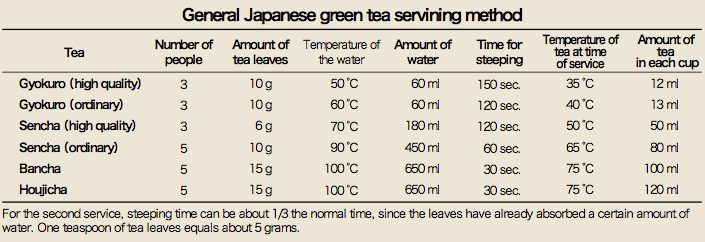
Preparation Table
Source: World Tea Association
The manufacturers of the individual teas deliver almost always with specific recommendations for the brewing time and the temperature in the Teepackung. However, at this point I would like to emphasize that in my view, from a health point of view basically two minutes brewing time are optimal.

Right temperature for the preparation

In addition to the brewing time, the right water temperature is the most important factor in the preparation of green tea. I also recommend here to learn exactly about the background.

Monday, September 9, 2013

Cast-Iron Teapots / Cast Iron Tea Kettle


Uncoated or non-enamelled cast iron teapots enhance the taste of tea and coffee, and can also improve the supply of iron.

Tetsubin


iron teapot - tetsubin
A tetsubin (Japanese:鉄瓶, "iron kettle") is a Japanese cast-iron boiler for the heating of water, especially for the treatment of flavor water  in the preparation of green tea, is used. Uncoated / without enamel Waser is cooked in it also a good source of iron (see below). Its shape is usually round, bulbous, globular, with a larger volume (typically 1-2 l, up to 5l) - but there are also smaller or flattened models (0.5 l). It has a large handle that makes it easy to hold even with heavy heat and a specially shaped spout, which allows an easy and convenient pouring. Tetsubins like to be embellished in the production of characteristic surface patterns and ornaments. Your inner layer consisted originally of pure uncoated iron. Today, most boilers are enamelled / coated to facilitate maintenance and to prevent rusting. But such coated boilers do not have positive influence on the taste and deliver no iron. 


Cast iron pots for better water taste

Cast iron pots were originally used exclusively for cooking water and not for pulling tea. Its real purpose is, in addition to heating the water, even in the refinement or influence the taste of water, which is an interesting and important new facet of the preparation for the enjoyment of tea. Water which has been heated in a high-quality uncoated cast iron pot, gets a much softer and even slightly sweeter taste. In particular, the aftertaste is deeper and longer lasting. This applies to all types of tea and incidentally also for many other preparations, such as drinking water, coffee and refined in the kitchen. The reason for the change of the water situated in the chemical interaction of the material of the iron vessel with the water molecules. In response also changes the consistency of the water. Its surface tension and the viscosity (degree of viscosity) is increased. It has changed not only the taste of the water itself, but also according to the order of the prepared tea or coffee. The water molecules to react chemically intensive way with the flavorings in tea or coffee water. The flavor characteristics vary depending on the quality of the Tetsubins, the surface of the Innneseite and its material composition. Experts even recommend the tetsubin on the key of the kyusu used for infusion vote because it is very different interactions of the minerals in the water and the sound here. So for the best taste, it depends on a combination of the best water quality and a matching Tetsubins and a kyusu and the appropriate type of tea.


Supplier of iron in the diet

In addition to this property, the water is enriched with iron. For people with an insufficient supply of the essential trace element iron a Tetsubi can offer a very interesting solution as a dietary supplement. As the dissolved iron in my experience even extremely bioavailable. But beware, this method is relatively much iron is taken to boil water for longer. And too much iron can cause serious health problems in the body. It is therefore necessary to determine exactly how the ferruginous own everyday food is already and how intensely you can use this method of preparation / should. People with an adequate iron supply, especially consumers of meat, should here more cautious approach to the matter, and this also can be in everyday use of water from a Tetsubi only a maximum of one minute simmer. People with a lower intake of iron, especially vegetarians and vegans can simmer longer leave the Tetsubi targeted use (depending on desired intensity up to 30 minutes) and the water as an excellent source of iron. However, I would not recommend this use more than twice a week. Cooked in this way water but will be detrimental to the taste of tea.


Qualities and coating / Enamel


Enamel with flowers - painting
Cast iron pots are made either by casting from molten iron in clay molds or in molds of sand. In the cheap mass production only the forms come from sand to use. Hand-made, high-quality boilers are cast in clay molds.

Tetsubins clay molds are made in Japan since the mid-16th Century and were originally made pure manual work, which was developed specifically for the tea ceremony. Their culture has survived to this day. Such Tetsubins show for its taste and excellent in quality. The local market for cast iron Teekannnen but with cheaper industrially produced mass products - dominated, which are also mostly enamelled inside / coated to prevent rust - mostly from China. They are also often thought contrary to the original function of the heating of pure water, for pulling and tea are supplied with tea strainers. But such enamelled / coated cans have no positive effect on taste and also provide no iron for additional supply of this trace element.

Recommendation from a health perspective

The heating of water in a high-quality uncoated Tetsubin causes undoubtedly a positive influence on the taste of water and tea, if you can cook it in just one minute or less. If you do not oversupplied with iron, or even when one is under-supplied, one also obtains a more useful and high-quality supply source. In contrast, we do not recommend the use of the tea enamelled / coated iron cans. Both taste and energy have these significant disadvantages over a kyusu from natural clay or a glass jar with the right tea strainer. 


Important tips for using a Tetsubin 

Traditionally, the tetsubin was heated above an open (coal) fire. In the traditional tea ceremony Chanoyu (茶の湯) or sado, Chado (茶道) this is done on the specific coal vessel Binkake (瓶 挂).

  • Fill with water only up to slightly below the level of an infusion.
  • Heat the tetsubin never without it contains enough water. The material can crack and otherwise may make the pot useless.
  • Use only a little heat as possible, otherwise the material suffers with time.
  • Not coated / enameled iron pots can be used on an open fire and gas burners. Cans of different materials threaten to crack because the different materials expand differently when heated.
  • Once the water boils, reduce the heat and let it just simmer for at least 1 minute. This waiting time is important because the whole Tetsubin should be heated. Then the water for the pouring of tea is ready
  • If the water is intended for the supply of iron and not for tea water, we recommend it easy to simmer for about 30 minutes. Then it is ready to drink. Do not use such longer boiled water for tea.
  • Be careful when removing the cover, as it is very hot.
  • Pour all the water after boiling out of the pot. Do not use the tetsubin for the storage of water.Otherwise it will be rust.
  • Let the rest tetsubin with open lid after use and dry. If you want to avoid rust stains and in particular can be in the drying of droplets or very wet places by the use of a blow dryer, or a small bellows, eg from the photographic help out. Use inside the boiler but no towels.
  • Do not clean the inside of the Tetsubins. Not even with a towel. Wipe or scrub the inside in any way.
#cast iron tea kettle #cast iron tea kettle dragon #cast iron tea kettle for wood stove #cast iron tea kettle humidifier #cast iron tea kettle japanese #cast iron tea kettle lodge #cast iron tea kettle sets #cast iron tea kettle steamer #cast iron tea kettle warmer #cast iron tea kettle with infuser


Friday, September 6, 2013

Green Tea - and Caffeine Steeping Time

Reduce caffeine content in green tea by shorter or longer steeping time? Tips in Dealing with caffeine sensitivity to green tea.

Sensitivity to caffeine in green tea

Is an increased sensitivity to caffeine in green tea before, with symptoms such as nausea, nervousness, can not sleep, etc., many people first think only of how you could reduce the caffeine content and inquire about the caffeine content in mg for the various teas. Usually disregarded is the consideration of whether the symptoms could not make a fundamental physical problem or a disease significantly. This is usually the case in my view, provided that the tea was cooked properly and is not polluted. Of course you should leave diseases and problems treated by an experienced doctor or medical practitioner.

Reduce caffeine in green tea

In addition, I recommend to make the Teeverzehr and thus reduce the negative symptoms disappear completely as possible. In this paper, caffeine in green tea reduce you to find the most important tips.

Reduce caffeine by steeping time?

A frequently asked question is whether it is possible and useful to reduce the caffeine in the green tea infusion period. The answer is no unfortunately both. This is suggested in my view for the following reasons:
  1. The caffeine dissolves relatively quickly in water. After only about 30 seconds brew time, a significant portion is converted into water, but very few other valuable substances. The optimal health benefits taking into account all active components of green tea unfolds in my estimation, but after exactly 2 minutes.
  2. From about 1-2 minutes many important ingredients are dissolved in the water for tea, caffeine in the body that make the sound. It depends not only on the sheer amount of caffeine, but particularly on the combination and bond with other substances. In particular, the amino acid L-theanine plays an important role. You will be solved only significantly during that period.
  3. A longer steeping time affected the Wirkstoffmix than 2 minutes in a very negative way. The caffeine is released after this period almost entirely in the water. While going with increasing duration now even more clearly tannins into the water (eg tannins) and bind the caffeine stronger, but at the same time are the most important other substances which increase the compatibility (eg, L-theanine), largely impaired.
The caffeine in green tea has in the interaction with the other ingredients of a particular health significance and effect. In a present sensitivity to this substance should only be taken in dose tolerated, but still in the correct preparation to be.

Tuesday, September 3, 2013

Caffeine and Tea

green tea plantation

Caffeine and green tea: Comparison mg of caffeine content per green tea variety, coffee, black tea, etc. effect of preparation, temperature, infusion and tips.


The caffeine in tea

The caffeine (or caffeine) is contained in some 60 plant alkaloid (1,3,7-trimethylxanthine) from the substance group of xanthines. The names Tein and Thein (or even falsely theine) are equivalent to the caffeine in tea, but are in professional circles as outdated. It is bitter tasting and has a strong stimulating effect, which is why it has been used in Asia for millennia by Buddhist monks for meditation. Caffeine is one of the phytochemicals and is mainly used for insect repellent made. In green tea, it is bound in a special form and interact strongly with L-Theanine and has as according to numerous studies, many extremely positive effects on health that are unfortunately too little known.

The complex issue of caffeine is to consider the following key points:

Caffeine content in mg tableComparison of coffee, espresso, etc. and the main types of tea
And caffeine steeping timeHow does the caffeine content by prolonged infusion time?
Healthy effectNumerous positive effects on the health
Recommended limit 300 mg per day?
Caffeine teas armsBancha and Karigane, Kukicha
Tips in Dealing with caffeineTeas and times, preparation

Comparison caffeine (mg) teas

The comparison of the amount of pure caffeine from coffee, green tea, black tea and other caffeinated drinks is often not done precisely. For one thing - as listed above especially crucial - if the caffeine is bound to tannins and what other ingredients are available. On the other hand, the caffeine content varies depending on the type of tea. Then, it's ultimately not just about the caffeine content in the dry matter, but how much coffee or tea is used for brewing a cup and how much is released into the water during brewing. A comprehensive comparison is given in the table in mg of caffeine .

Caffeine in green tea by type

It should be emphasized that the various types of green tea have a very different caffeine content. This ranges from the shaded tea Gyokuro, Tencha and matcha with a particularly high amount (similar to coffee), the still high level of Sencha (unshaded tea from the leaves) of the first harvest, slightly lower values ​​of Sencha second plucking and the variety Benifuuki, to the relatively low content in the mixed rice with sencha (Genmaicha), the older leaves of the tea (Bancha) and the tea made ​​from the stems of the tea plant (Karigane / Kukicha), which only very little contains caffeine. However Karigane from Gyokuro contains a little more caffeine than Karigane from Sencha. The caffeine content is determined primarily by three factors:
  1. Young plant parts (buds and young leaves small) have significantly more caffeine than older plant parts (leaves and stems older).
  2. The first picking = harvest has significantly more caffeine than the second plucking.
  3. Shaded teas (eg, Gyokuro, Tencha, matcha) have much more caffeine than unshaded tea (Sencha, Bancha, Karigane, Kukicha, Benifuuki).

Infusion and caffeine concentration

Another common question is whether one can influence the caffeine content of tea by a shorter or longer infusion time. For example, if a caffeine-sensitive person could do a better Gyokuro evening when a certain time drawing would be selected. We have all heard the old rule: "For tea, the caffeine content is increased by a longer brewing time". The answer is that this approach is to look critically at green tea for various reasons. Details, refer to the contribution of green tea and caffeine steeping time .

Water temperature and caffeine content

It raises the question whether one can influence the caffeine content by selecting the water temperature of the infusion. The primary answer is no. Even at a temperature of only 60 degrees Celsius, already the majority of the caffeine dissolves relatively quickly in water. Decreasing the temperature is below 50 degrees Celsius to solve Although less caffeine, but hardly more important and other healthy ingredients into the water and still achieve a disproportionately high level of caffeine. Increasing the temperature well above 60 ° C so you lose important ingredients that make caffeine-friendly. The caffeine is chemically unstable at much over 100 degrees Celsius (sublimed from 178 degrees Celsius).

Caffeine in Coffee vs. Tea

caffeine coffee

Coffee beansThe warning voices against the consumption of coffee and its caffeine are numerous. And not without reason. Because the substance is different than in green tea not bound to tannins in coffee, but to the so-called chlorogenic acid. No amino acids in coffee also exist (particularly the L-theanine) as they are available in green and partially in black tea that will make the effect of caffeine much better tolerated. Given the lack of binding to tannins it reaches the coffee through the stomach into higher speed in the bloodstream and causes the lack of effect of combination with amino acids starting from a relatively low consumption of an unrestrained effect or overdose, to a tolerance education in the nerve cells and withdrawal symptoms . The caffeine in coffee arrives for its lack of attachment to the aforementioned substances through the bloodstream to the adrenal cortex. There it triggers the release of the stress hormone adrenaline, which is highly stimulating. To reduce the adrenaline again, it is the body norepinephrine distribute. The unbound caffeine has only a short-lasting effect. This process is stressful for the body and overall energy costs. After the stimulating effect of the organism is therefore even more exhausted than before.

Caffeine in black tea

The same applies to the other stimulant caffeine, such as the black tea or drinks. Again, the caffeine in high doses similar to quickly get into the body, since here also lacks binding to the tannins and the buffering by L-theanine something smaller. The black tea tannins are converted by the fermentation flavors. It is emphasized, however, that in contrast to coffee, a higher content of amino acids present, which is still significantly exceeded by the content in green tea. Thus the caffeine of black tea in the body seems a bit friendly, as the coffee, but still much more burdensome than that of green tea.

The particular caffeine in green tea

As in the preparation of tea, the fermentation of the green leaves of the tea plant is stopped, the remain ingredients of green tea by the process of oxidation and the resulting chemical changes largely spared. Thus, the caffeine in the abundant tannin remains - unlike the black tea and the coffee - bound in green tea. Another important difference is the high content of amino acids in green tea, especially the L-Theanine. See also the article and comparing teas . This bond and the effect in conjunction with the other ingredients makes a big difference to the other caffeinated beverages dar. Because the green tea, the caffeine reaches for his Gerbstoffbindung mainly through the intestine into the blood, and acts in rotation with other valuable ingredients on a very mild and prolonged Art This property can flourish very well the very healthy side of caffeine in the human body.

Unlike the caffeine of coffee, the bound caffeine in green tea does not or hardly directly on the adrenal cortex. Rather, it stimulates the central nervous system at first, which then leads to a much smoother distribution of adrenaline. Accordingly, also norepinephrine, if ever, be used only gently. The effect of the caffeine of green tea keeps thereby also significantly longer.

Positive health effects of caffeine

green tea health
It is used in the health effects of the caffeine so not only the content of the beverage in milligrams (mg), but rather to its interaction and binding with the other ingredients. Numerous studies have pointed to the positive effects of caffeine in green tea.

It should be emphasized that studies have highlighted in recent years, very healthy properties of the self is not bound to tannins caffeine in coffee (particularly in the type of coffee Arabica). This finding seems to spread more and more. Of course, this only applies to consumption of relatively small amounts. In general, the limit of about here is often 300 mg daily called for a healthy adult.

A much healthier effect unfolds but the caffeine in green tea. Here are exceedingly numerous positive effects for health. So the caffeine contributes significantly to the overall excellent health effects of green tea on. However, side effects such as nausea, nervousness, upset stomach, or similar to, it is recommended that measures should be taken until the symptoms are tolerable, or disappeared completely.

Side effects of caffeine in green tea

People react differently to the caffeine in green tea. Although it is here bound to tannins and with L-theanine is compatible, it can still significant side effects show that of falling asleep can not reach dizziness, stomach pain and headache. Furthermore, it is recommended that during pregnancy, no caffeine is ingested and thus no green tea should be drunk. Babies can not break down the caffeine. The recommendation applies even up to 10 weeks of pregnancy, if the mother should feed the baby. According to studies, a significant caffeine intake of about 8 cups of coffee per day leads (about 300 mg of caffeine) to an increased risk of miscarriage and premature birth. But already at 1.5 cups of coffee showed certain studies have negative effects on the baby (lower birth weight). An alternative is the use of Sencha Karigane because this leg has very little caffeine. But our recommendation is in pregnancy and lactation: general waiver of green tea and caffeine.

What to do with sensitivity to caffeine green tea

The strong health benefits of green tea can cause caffeine sensitivity in adequate green tea consumption on its own over time is significantly reduced and possibly better. Also be emphasized that the green tea does not addicted to caffeine as opposed to coffee. Nevertheless, recommended for side effects very not "hineinzuzwingen" in the tea, but to reduce the dose to a tolerable level (but at the proper preparation to stay) to select and pleasant for the time of day tea places. It is very important to drink shortly before or after the green tea plenty of fresh sparkling water. People with increased sensitivity should drink at least the same amount of water. The best advice on how to cope better with the green tea and its caffeine, see the article " Tips in dealing with the caffeine in green tea . "